
PRAISE FOR THE DEVIL’S CHOW
A Chinese Food History
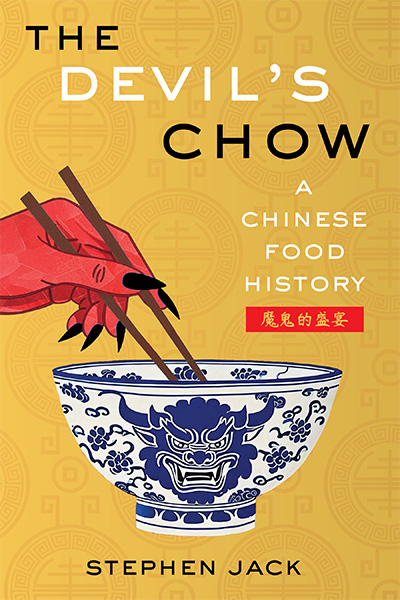
EDITORIAL REVIEWS of The Devil’s Chow (long versions)
Professor Emeritus E. N. Anderson, author of The Food of China
“Stephen Jack’s book is a terrific read. Mr. Jack is an Australian who has lived for 30 years in East Asia, mostly in Taiwan. In this book, he tells some of his more colorful adventures, interspersing them with a history of Chinese food from earliest times to the present. He has rambled all over China, taking local transportation and taking potluck with anyone he meets at mealtime. He recounts a heroic capacity for food and alcohol.
His observations on the present, as he has experienced it, rather steal the show, but the history is strikingly accurate—a major accomplishment in this age of tall stories about Chinese food. (The Chinese love to make up these tales, and the western world often adds more.) The history of Chinese food has plenty of color of its own, without fiction, and Mr. Jack brings it out very well.
Mr. Jack is a master of the Australian tradition of yarning: telling well-crafted stories that come to a sharp point. As the Chinese say: “As for composing prose, there are three principles. Begin the work like a tiger’s head, showing its fierceness and weight indeed (ye). The middle should be like a pig’s belly, showing its richness and abundance indeed. The end should be like a scorpion’s tail, to show how the poison comes out when it stings indeed” (attributed to Wang Wentong, 13th century). The points of Mr. Jack’s stories are not so poisonous; they are excellent observations on food in general and the Chinese ways with it, especially in modern situations.
The book maintains a fine balance between tales of the open road in China and historical and agricultural data. Once I started it, I couldn’t stop except to eat and sleep until I finished it. A great way to learn about Chinese food.”
Scott D. Seligman, co-author of The Cultural Revolution Cookbook
“Stephen Jack not only knows a hell of a lot about Chinese food; he also knows how to turn a phrase. He takes readers on a lively ‘Cook’s tour,’ far beyond Benign Chinese Foodland, the Chinatowns of his native Australia – think chop suey and chow mein – to exotic Barbarous Chinese Foodland, the villages and back alleys of China, where you’re more likely to find chicken gizzards and pickled mustard greens – the stuff real Chinese people eat. And like the best guides, he is part historian and part storyteller, with an infectious passion and enthusiasm for his subject. Don’t read this book on an empty stomach.”
Professor Isaac Yue, editor of Scribes of Gastronomy: Representations of Food and Drink in Imperial Chinese Literature
“When I first picked up The Devil’s Chow: A Chinese Food History by Stephen Jack, I wasn’t quite sure what to expect. Having read many Western accounts of Chinese cuisine that often focus on its exoticism and cultural shock, I found Jack’s work to be refreshingly ambitious and comprehensive. Part history lesson, part travelogue, and above all, a personal journey through the flavors and stories that define Chinese food, this book offers a richly textured exploration of China’s many culinary traditions. Filled with compelling dialogue and keen observations, I highly recommend it to anyone who is eager to understand China’s culinary heritage, passionate about travel writing, or simply curious about one man’s immersive adventure into the heart of Chinese cuisine.”
“A man sets off on a culinary journey across China to trace the history of one of the world’s most enduring cuisines in this nonfiction work. Inspired by his love of Taiwan, where he still lives today, in this work, Jack delves into the culinary history of China over the course of four distinct “Journeys” that cover specific chronological and regional spans, including the initial appearance of Homo erectus in North China 800,000 years ago (Journey One), the Sui and Tang dynasties (Journey Two), the Yuan and Ming dynasties (Journey Three), and the modern-day People’s Republic of China (Journey Four). Jack connects the land’s cultural, geographical, and religious history to the establishment of its distinctive ingredients and dishes: “Most of the foundational ingredients of Chinese cuisine can be traced to the Neolithic (11500–2000 B.C.), when millet, rice, pigs, poultry and fish were domesticated.” Anecdotes from the author’s travels are sprinkled throughout the text; in one, Jack is informed by a Buddhist monk that smoking is discouraged. (“Haven’t you heard? Smoking is bad for your health.”) The culinary timeline concludes with modern-day China as the author explains how watered-down versions of its cuisine became popular in Western cultures. With a no-frills narrative voice, Jack delves so deeply into the region’s food culture that even those well versed in authentic Chinese cuisine will likely learn something new. Fans of stinky tofu, for example, might not know that a special type made south of Kunming literally grows a furlike substance. When it comes to broader history, however, the book has one glaring understatement that’s sure to rankle anyone with basic knowledge of human rights: The author reductively states that “the full might of the constabulary [has been] brought to bear” in response to Uyghurs (Muslims) protesting their circumstances. This throwaway statement glosses right over the Uyghurs’ atrocious mistreatment at the hands of the Chinese government; in a book that includes plenty of history that’s not strictly food-related, this seems like a mind-boggling omission. Still, as a chronicle of Chinese food both familiar and surprising, the narrative hits the spot.
A fascinating culinary memoir with occasional historical blind spots.” “Our Verdict: GET IT“