
THE DEVIL’S CHOW
A Chinese Food History
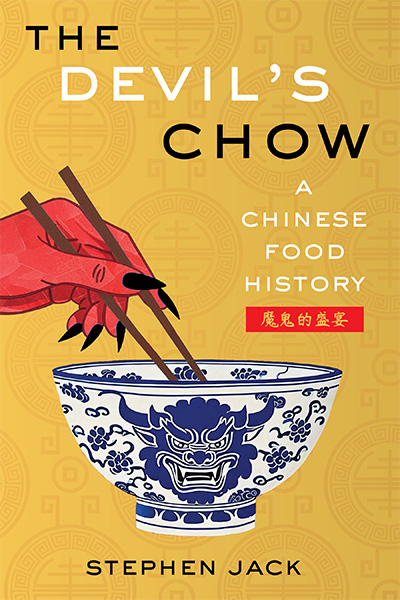
The Devil’s Chow, a Chinese food history book by Stephen Jack is newly released by Cold Press Books.
In The Devil’s Chow, Stephen Jack traverses China to tell the monumental story of how Chinese food evolved from the earliest times into the unique cuisine it is today. From the cave home of Peking Man to the deserts of the Silk Road; from the southern tribal borderlands to the country’s megacities, he reveals the ancient mysteries and the modern realities of Chinese food, perhaps the most sophisticated yet confronting cuisine in the world.
- Why do Chinese people cook with woks and eat with chopsticks?
- Do Chinese really eat dogs and cats?
- Why did pottery appear in China 13,000 years earlier than in the West?
- Did Marco Polo teach Italians to make spaghetti after discovering noodles in China?
- How did a chef in ancient times rise to become prime minister?
- Is chop suey a genuine Chinese dish or was it invented in America?
- With its vast population, why is China running out of farmers?
- Why are more than half of Chinese adults overweight or obese?
The Devil’s Chow is one of the few books for the general reader that tells the story of Chinese food history in its entirety.

PRAISE FOR THE BOOK
“A fascinating culinary memoir …. Jack connects the land’s cultural, geographical, and religious history to the establishment of its distinctive ingredients and dishes …. With a no-frills narrative voice, Jack delves so deeply into the region’s food culture that even those well versed in authentic Chinese cuisine will likely learn something new …. As a chronicle of Chinese food both familiar and surprising, the narrative hits the spot. Our Verdict: GET IT“
Kirkus Reviews
Read Full Review
“Despite all the books about Chinese food, every now and then there comes a masterpiece. The Devil’s Chow is a personal and moving encounter with Chinese food history is one of them. It is packed with fascinating anecdotes and stories on one of the world’s greatest cuisines. A book that deserves to be in the library of anyone who loves food!”
Ken Hom, CBE, Author, Chef & TV Presenter
“Stephen Jack’s The Devil’s Chow is both a meticulous intellectual inquiry and a visceral travelogue. It takes readers on a mesmerizing 18,000-mile and centuries-long culinary odyssey to uncover the evolution of the cooking of China, one of the world’s most sophisticated cuisines, and debunk popular misperceptions and myths about it. It is an essential and enjoyable companion for food lovers, curious travelers, and food scholars alike.”
Yong Chen, author of Chop Suey, USA: The Story of Chinese Food in America
“Stephen Jack’s book is a terrific read …. His observations on the present, as he has experienced it, rather steal the show, but the history is strikingly accurate …. The book maintains a fine balance between tales of the open road in China and historical and agricultural data. Once I started it, I couldn’t stop except to eat and sleep until I finished it. A great way to learn about Chinese food.”
Professor Emeritus E. N. Anderson, author of The Food of China
Read Full Review
“Stephen Jack not only knows a hell of a lot about Chinese food; he also knows how to turn a phrase. He takes readers on a lively ‘Cook’s tour,’ … And like the best guides, he is part historian and part storyteller, with an infectious passion and enthusiasm for his subject. Don’t read this book on an empty stomach.”
Scott D. Seligman, co-author of The Cultural Revolution Cookbook
Read Full Review
“Part history lesson, part travelogue, and above all, a personal journey through the flavors and stories that define Chinese food, this book offers a richly textured exploration of China’s many culinary traditions …. I highly recommend it to anyone who is eager to understand China’s culinary heritage, passionate about travel writing, or simply curious about one man’s immersive adventure into the heart of Chinese cuisine.”
Professor Isaac Yue, editor of Scribes of Gastronomy
Read Full Review
“In The Devil’s Chow, Stephen Jack launches into a lively, immersive account of his dive into the experience and history of eating in China. With an eye for the unexpected and a driving curiosity, the author overturns tropes and clichés of China’s history and reputation, and reaches a fascinating new understanding. A combination of visceral gustatory delight and deep curiosity about culture and history makes The Devil’s Chow a delight. Bon appetit!”
David Taylor, author of Ginseng, the Divine Root, and Cork Wars: Intrigue and Industry in World War II
GOODREADS REVIEWS
EXCERPTS FROM THE BOOK
On the Invention of Chopsticks
“How a matching pair of thin sticks came to be used in one hand like tongs or finger extensions remains a mystery, but chopsticks have proved themselves ideal utensils for eating certain kinds of dishes. Chopsticks are such a simple device that their invention seems more a triumph of dexterity than of technology.”
On Baozi Buns
“A well-formed baozi has a pleated top that gives it the appearance of a puffed-up ivory flower. Baozi are cooked in distinctive circular lattice steamers; interlocking stacks of these can be seen at restaurants—bamboo chimneys billowing aromatic steam. The most succulent baozi are cooked to order and eaten right from the steamer.”
On Daoism and the Development of Chinese Food and Medicine
“Later, Daoists, in their quest for immortality, grabbed the reins of this alchemical tradition and rode it with a vengeance. Daoist seekers scaled misty mountains, crossed vast deserts and navigated the vagaries of the high seas, all to get their hands on exotic plants, creatures or minerals to experiment with. While the elixir of life eluded them, they discovered decoctions of death and sickness time and time again as potions despatched alchemists and sometimes even emperors.”
On the Spread of Chinese Culinary Ways Around the World
“Chinese is the most commonly eaten cuisine on the planet. Its role in sustaining China’s 1.4 billion people is enough to see to that, but its appeal, of course, doesn’t stop at the border. The distinctive aromatic blend of sizzling soy sauce, ginger and spring onions has wafted into just about every major settlement on earth. Over time, slowly but surely, stomach by stomach, the Chinese diaspora, armed with woks, cleavers and spatulas, conquered the world with their unique style of cooking.”
On Dim Sum
“My second dim sum dish of the day: cha siu bao, savoury-sweet roast pork encased in gaping steamed buns as fluffy as cumulus clouds. It was my final meal in China and I was thinking, this had better be good. And it was.”
–See also A Brief History of Chinese Food
Adapted from The Devil’s Chow
ABOUT THE AUTHOR
Stephen Jack hails from Bendigo, Australia, home to one of the oldest Chinese restaurants in the world. A former train driver, teacher and journalist, he lives in Taiwan where he works as a copywriter, marketing consultant and writes about Chinese food. He has appeared on the television series Bizarre Foods, and his writing has featured in various publications.
FURTHER INFO / AUTHOR FAQ
Is The Devil’s Chow a non-fiction book?
Yes, narrative non-fiction.
What’s the book about?
It’s the story of my search for the origin and evolution of Chinese cuisine. It combines history, food and travel.
Is it a cookbook?
No.
Is it a guidebook?
No, if you are looking for nitty gritty info on restaurant locations and prices, etc., get an actual guidebook. The Devil’s Chow is a culinary travel memoir with a historical framework, sprinkled with fact and folklore. But if you are travelling to China and interested in Chinese food, you will find inspiration in the book and you can visit some of the places mentioned, though few eateries are identified by name.
How long is the book?
The paperback is 398 pages.
Does the book include a map?
Yes, a simple one indicating the regions I visited.
Who is the book aimed at?
The Devil’s Chow was written for readers who are interested in food, travel and history. This trek across place and time, uncovering the culinary world of the Chinese—the most food-centric people on earth—will appeal to home cooks, foodies, armchair travellers and actual travellers to China.
Dining is a highlight of any China trip but with the dramatic rise of food tourism, more and more visitors are seeking deeper, hands-on gastronomic experiences. Many China-bound foodies will consider The Devil’s Chow an essential companion to a standard guidebook.
Why is the book titled The Devil’s Chow?
While the book is primarily a travel memoir and a history of Chinese cuisine in China, I also discuss the Western reaction to Chinese food after it arrived in America, for example. In the early days of Chinese immigration especially, it was viewed with great suspicion. Stories of Chinese culinary ‘exotica’ – whether real or imagined, followed Chinese cooks wherever they set up shop.
As I write in the book, even much much later “When I was growing up, if a pet dog or cat went missing, some joker would say, “Better not order Chinese for a couple of weeks.” The underlying suspicion never entirely went away that Chinese cooks might be substituting Porky with Fido or Kitty.”
The phrase the ‘Devil’s chow’ is my own and is meant to embody this negative if misguided view.
Did you visit China?
Yes, I made a number of visits to China in the course of researching and writing the book.
Did you travel to Taiwan?
No, I am based in Taiwan so I already know the country and its cuisine well enough. Though Taiwan isn’t a featured destination in the book, the place and its food are referenced frequently.
Number of regions visited in China
Thirteen: Beijing, Henan, Shanxi, Shandong, Zhejiang, Jiangsu, Anhui, Gansu, Xinjiang, Inner Mongolia, Yunnan, Sichuan, Guangdong.
Distance travelled in China by the author
30,000 km (18,000 miles).
Modes of transport used by the author
Train, bus, plane, bicycle, and beast of burden (camel).
Number of meals eaten by the author on his travels in China
About 420, not including snacks and drinks!
Best meal eaten
The sumptuous water banquet in Louyang, Henan. Twenty-four courses of expertly prepared food, served slowly like ‘flowing water.’
Most confronting dish
Wangjidan in Nanjing, a fertilised chicken egg eaten directly from the shell. “Never have I eaten cooked food that seemed so raw, so primal.”
Favourite place visited?
Probably Kashgar in Xinjiang because being mainly a Uyghur town, it’s culturally very different than most cities in China. And, Yunnan Province, just for its sheer diversity of geography and human cultures, something that is reflected in the food there.
ISBN
Paperback: 978-6-269-96942-5 / Ebook: 978-626-99694-1-8
Library Categories: Narrative non-fiction, Chinese Food History, Chinese Food, Chinese Cuisine, Chinese Food Culture, China Travel, China History.
Chinese Title 中文書名: 魔鬼的盛宴